


Storage in Pakistan: Complete Guide to Safe & Secure Storage
What happens when you have to leave your current home but your new property is not ready yet? Or when your house is being renovated, your office is relocating, or you are moving to another city?
In these situations, storage in Pakistan can provide a practical solution for keeping furniture, household belongings, cartons, office equipment and other permitted items until you are ready to use them again.
Instead of moving everything into a temporary home and then moving it again, you can arrange storage between your old and new locations. Depending on your requirements, storage may be needed for a few days, several weeks or several months.
This guide explains how storage works, when you may need it, what can be stored, how to prepare your belongings, how storage costs are calculated, and what to look for when choosing a storage company.
Why Do People Need Storage When Moving?
A move does not always happen from one property directly into another. There can be a gap between your move-out date and your move-in date.
Common situations where storage can help include:
- Your new house is not ready.
- You are waiting for property possession.
- Your home is undergoing renovation.
- You are moving out of rented accommodation.
- You are temporarily staying with family or in furnished accommodation.
- You are downsizing to a smaller home.
- You are selling your current property.
- You are moving to another city.
- You are temporarily relocating abroad.
- Your office is being renovated or relocated.
- You need to clear a property before construction or remodeling.
For example, someone moving from Karachi to Lahore may need to vacate their current property before the new house is ready. Instead of arranging another temporary residence for all their furniture and cartons, storage can provide a place to keep those belongings until delivery is required.
If you are planning an intercity move, our Moving from Karachi to Lahore also covers important planning and transportation considerations.
When Should You Consider Storage?
Storage is not necessary for every move. If your new home is ready on the same day you leave your old property, direct transportation may be the simplest option.
Storage becomes more useful when there is a delay or another practical reason to keep your belongings somewhere else.
| Situation | Is Storage Useful? |
|---|---|
| New home is not ready | Yes |
| Property renovation | Yes |
| Temporary accommodation | Yes |
| Moving abroad temporarily | Yes |
| Downsizing | Yes |
| Office renovation | Yes |
| Office relocation | Yes |
| Waiting for property possession | Yes |
| Moving directly into a ready home | Usually not necessary |
| Only a few cartons need temporary space | Depends on your situation |
A simple question can help:
Do you need to keep your belongings somewhere safe between two locations?
If yes, temporary storage may be worth considering.
Short-Term vs Long-Term Storage
Storage requirements vary depending on how long you need your belongings kept away from your home or office.
Short-Term Storage
Short-term storage may be useful for:
- A few days
- Several weeks
- A short renovation
- A delayed move-in date
- Temporary accommodation
- A short gap between two properties
For example, if you need to vacate your rented house at the end of the month but your new home will only be ready after two weeks, short-term storage can bridge that gap.
Long-Term Storage
Long-term storage may be suitable when belongings are not required immediately.
Examples include:
- Extra household furniture
- Furniture kept during downsizing
- Office equipment
- Business belongings
- Items kept during extended relocation
- Furniture stored while a property is being renovated
- Seasonal or rarely used belongings
The longer items remain in storage, the more important proper packing, labeling, inventory management and suitable storage conditions become.
Types of Storage Services
Storage requirements are different for every customer. A family storing household furniture may have completely different needs from a company storing office equipment.
Household Storage
Household storage may include:
- Sofas and chairs
- Beds
- Dining tables and chairs
- Cupboards and cabinets
- Appliances
- Clothes
- Books
- Kitchen items
- Cartons
- Home décor
- Seasonal belongings
Before storage, household goods should be cleaned, dried, packed and labeled properly.
Furniture Storage
Furniture requires additional attention because of its size, weight and surface materials.
Large furniture may need to be dismantled before transportation. Wooden surfaces, upholstery, glass and polished finishes should be protected against scratches, dust and rough handling.
Keep screws, brackets and other fittings together in labeled bags so the furniture can be reassembled later.
Office Storage
Businesses may need storage during:
- Office relocation
- Renovation
- Downsizing
- Temporary closure
- Expansion
- Change of premises
Office storage can include desks, chairs, cabinets, files, shelving, equipment and other business belongings.
An inventory becomes especially useful for office storage because businesses may need to locate specific equipment, files or furniture when the new office is ready.
For businesses planning a complete relocation, our Moving Your Office to a New Location provides additional guidance on organizing an office move.
Large Items and Vehicle-Related Storage
Some belongings require special planning because of their size or handling requirements. These may include oversized furniture, machinery or vehicles.
However, vehicle transportation and vehicle storage are not the same service. Always confirm whether the provider offers actual vehicle storage or only transportation.
For oversized items, provide photographs, dimensions and details before requesting a quotation. This helps determine the appropriate transportation and storage arrangement.
How Professional Warehouse Storage Works
A professional moving and storage process generally follows this sequence:
Survey → Packing → Inventory → Loading → Transportation → Warehouse Receiving → Storage → Retrieval → Delivery
1. Survey and Planning
The storage provider first needs to understand what you want to store.
An item list, photographs or an in-person survey can help estimate the amount of space required and identify items that need special handling.
2. Packing
Furniture, cartons and fragile belongings are prepared according to their type and handling requirements.
3. Inventory and Labeling
Cartons and major items are identified so they can be located later.
4. Loading and Transportation
Items are loaded carefully and transported to the storage facility.
5. Warehouse Storage
Belongings are organized according to the storage arrangement so they can remain identifiable during the storage period.
6. Retrieval and Delivery
When your new home or office is ready, the stored belongings can be prepared for transportation and delivered to the new location.
This is one of the main advantages of combining moving and storage: packing, transportation, storage and later delivery can be planned as one relocation process.
How to Prepare Your Belongings for Storage
Proper storage begins before your belongings reach the warehouse.
Clean and Dry Everything
Remove dust, dirt and food residue before packing. Appliances and other items should be completely dry.
Disassemble Large Furniture
Where practical, dismantle beds, tables, wardrobes and other large items. Keep screws, brackets and fittings together in clearly labeled bags.
Protect Fragile Items
Glassware, crockery, mirrors, electronics and other fragile belongings should receive suitable cushioning and protective packaging.
Protect Furniture
Sofas, chairs, tables, cabinets and wooden furniture should be wrapped using appropriate protective materials.
Avoid Damp Items
Never put wet clothes, damp cartons or moist furniture into storage. Trapped moisture can create problems during longer storage periods.
Prepare an Inventory
Create a list of everything being stored and assign numbers to cartons and major items.
For valuable or delicate belongings, photographs can also provide a useful record of their condition before storage.
Packing and Labeling Items for Storage
Instead of writing only “Kitchen” or “Miscellaneous”, use a simple identification system:
- Box 01 – Kitchen – Crockery – Fragile
- Box 02 – Bedroom – Winter Clothes
- Box 03 – Study – Books
- Furniture 04 – Master Bedroom – Bed
Keep a master inventory that matches the numbers written on the cartons.
A useful practical rule is:
If you cannot identify a box six months later, the label is probably not detailed enough.
Professional packing and labeling can be particularly useful for customers storing a complete household because it reduces confusion when the belongings are eventually delivered to the new property.
For more information about organizing a complete residential move, see our Guide House Shifting in Pakistan
How Much Storage Space Do You Need?
The amount of storage space required depends on the volume and type of belongings, not simply the number of boxes.
Important factors include:
- Number of rooms
- Amount of furniture
- Number of cartons
- Appliance sizes
- Furniture dimensions
- Whether furniture is dismantled
- How efficiently items can be arranged
- Whether you need regular access to individual belongings
A lightly furnished two-bedroom apartment may require significantly less space than a fully furnished five-bedroom house.
This is why photographs, an item list or a professional survey can provide a better estimate than simply choosing a storage size based on the number of cartons.
How Much Does Storage Cost in Pakistan?
There is no single storage price that applies to every customer.
Storage costs can depend on:
- Total volume of belongings
- Required storage space
- Type of items
- Storage duration
- Packing requirements
- Loading and unloading
- Transportation
- Furniture dismantling
- Special handling
- Location
- Access requirements
For customers who are moving, the total requirement may involve several separate elements:
Packing + Transportation to Storage + Storage + Retrieval + Delivery to New Property
This is why a quotation based on your actual belongings is generally more useful than relying on a fixed price found online.
For example, storing a few cartons will obviously require less space and handling than storing the complete contents of a large furnished house.
How to Choose a Storage Company in Pakistan
Price is important, but it should not be the only factor when choosing a storage provider.
Before booking, ask the following questions.
1. How Are My Items Recorded?
Ask whether your belongings are labeled and recorded so they can be identified later.
2. What Are the Warehouse Conditions?
Ask how the facility protects belongings from dust, moisture, pests and other environmental issues.
3. How Is Security Managed?
Understand how access to the storage area is controlled and what procedures are used to protect stored belongings.
4. How Are Items Handled?
Ask who handles loading, unloading, warehouse movement and final retrieval.
5. What Are the Storage Terms?
Confirm the storage duration, payment arrangements, access policy and notice requirements.
6. Which Items Are Restricted?
Ask for a clear list of goods that cannot be stored or require special arrangements.
7. What Happens if an Item Is Damaged or Lost?
Understand the provider’s terms regarding responsibility, valuation and insurance before storing valuable belongings.
8. Can Transportation Be Included?
Combining transportation with storage can make the process considerably easier when you need to move out of one property and later move into another.
What Should and Shouldn’t Be Stored?
Most ordinary household and office belongings can be stored when properly prepared, but some items may be restricted.
Commonly Stored Items
These may include:
- Furniture
- Household cartons
- Clothes
- Books
- Appliances
- Office furniture
- Files and supplies
- Household equipment
- Non-perishable belongings
Items That May Be Restricted or Need Special Arrangements
Always ask the storage provider before storing:
- Perishable food
- Flammable materials
- Hazardous chemicals
- Gas cylinders
- Wet or damp goods
- Illegal items
- Cash
- Jewelry
- Certain temperature-sensitive products
Do not assume that an item is acceptable simply because it can physically fit inside a storage facility.
Moving From Home → Warehouse → New Home
One of the biggest advantages of professional moving and storage is that the entire process can be coordinated rather than handled as separate jobs.
A typical storage-assisted move can look like this:
Step 1: Survey and Planning
The quantity and type of belongings are assessed and the required storage arrangement is discussed.
Step 2: Professional Packing
Furniture, cartons and fragile items are prepared for transportation and storage.
Step 3: Inventory and Labeling
Items are identified and recorded for easier management and retrieval.
Step 4: Collection From Your Home
The packed belongings are loaded and collected from your current property.
Step 5: Transportation to the Warehouse
The belongings are transported to the storage facility.
Step 6: Storage
Your items remain stored until you are ready to receive them.
Step 7: Retrieval
When your new home or office is ready, the stored belongings are prepared for delivery.
Step 8: Transportation to the New Property
The items are transported to your new location.
Step 9: Unloading and Placement
Furniture and cartons are unloaded and placed according to the agreed moving requirements.
This approach is particularly useful when your move-out date and move-in date do not match.
Moving & Storage With Ishfaq Movers
If you need a temporary place for your belongings during a house move, office relocation, renovation or intercity move, combining moving and storage can simplify the entire process.
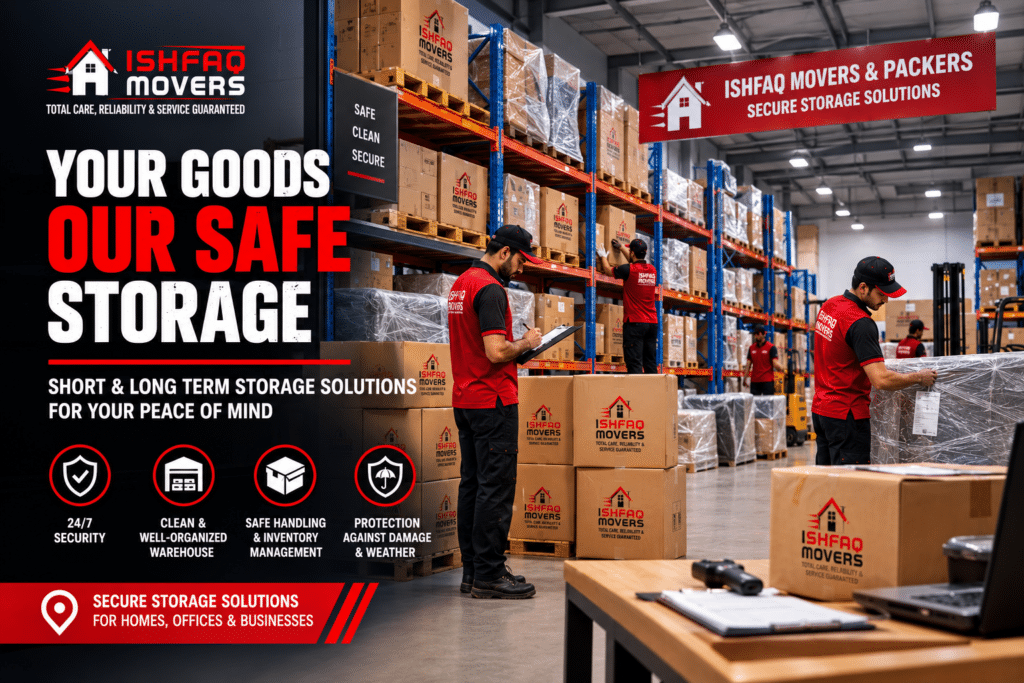
Ishfaq Movers and Packers offers short-term and long-term storage options, including shared and container storage arrangements, alongside moving services. The exact storage arrangement depends on the type and quantity of belongings and the customer’s requirements.
Instead of arranging packing, transportation and storage separately, customers can discuss the complete requirement and plan the movement of their belongings from the current property to storage and eventually to the new location.
For customers who need the complete solution, explore our Moving & Storage Services.
Frequently Asked Questions About Storage in Pakistan
What is storage service in Pakistan?
Storage service allows individuals and businesses to keep permitted belongings in a dedicated storage facility for a temporary or extended period. It can be useful during house shifting, renovation, office relocation and intercity or international moves.
How much does storage cost in Pakistan?
Storage cost depends on the amount of space required, type and quantity of belongings, storage duration, packing, transportation and handling requirements. A quotation based on your actual inventory is generally more accurate than a fixed general price.
Can I store furniture in a warehouse?
Yes, furniture can generally be stored when it is properly cleaned, dried, protected and handled. Large furniture may need to be dismantled before transportation and storage.
How long can household items stay in storage?
Household items can be stored for short or longer periods depending on the storage arrangement and provider’s terms. Proper preparation becomes increasingly important for belongings kept for an extended period.
Can I store my belongings while moving to another city?
Yes. Storage can be useful when you need to leave your current property before the new home is ready. Your belongings can be transported to storage and delivered when you are ready to move in.
What should I not put into storage?
Perishable food, flammable materials, hazardous chemicals, gas cylinders, illegal goods and certain sensitive items may be restricted. Always confirm the storage provider’s terms before storing these items.
Final Thoughts
Storage can be a practical part of moving when there is a gap between leaving one property and moving into another.
Whether you need short-term household storage, furniture storage during renovation, office storage during relocation, or longer-term storage for belongings you do not currently need, proper preparation can make the process much easier.
Clean and dry your belongings, protect furniture and fragile items, label cartons clearly, maintain an inventory, and understand the storage provider’s terms before booking.
If your move involves both transportation and storage, coordinating the entire journey from home → warehouse → new home can reduce unnecessary handling and make the relocation easier to manage.
For customers who need professional assistance, Ishfaq Movers and Packers can help plan the moving and storage requirements according to the type and volume of belongings.